eight children's books about partition
(And reflections on historical fiction as a genre)
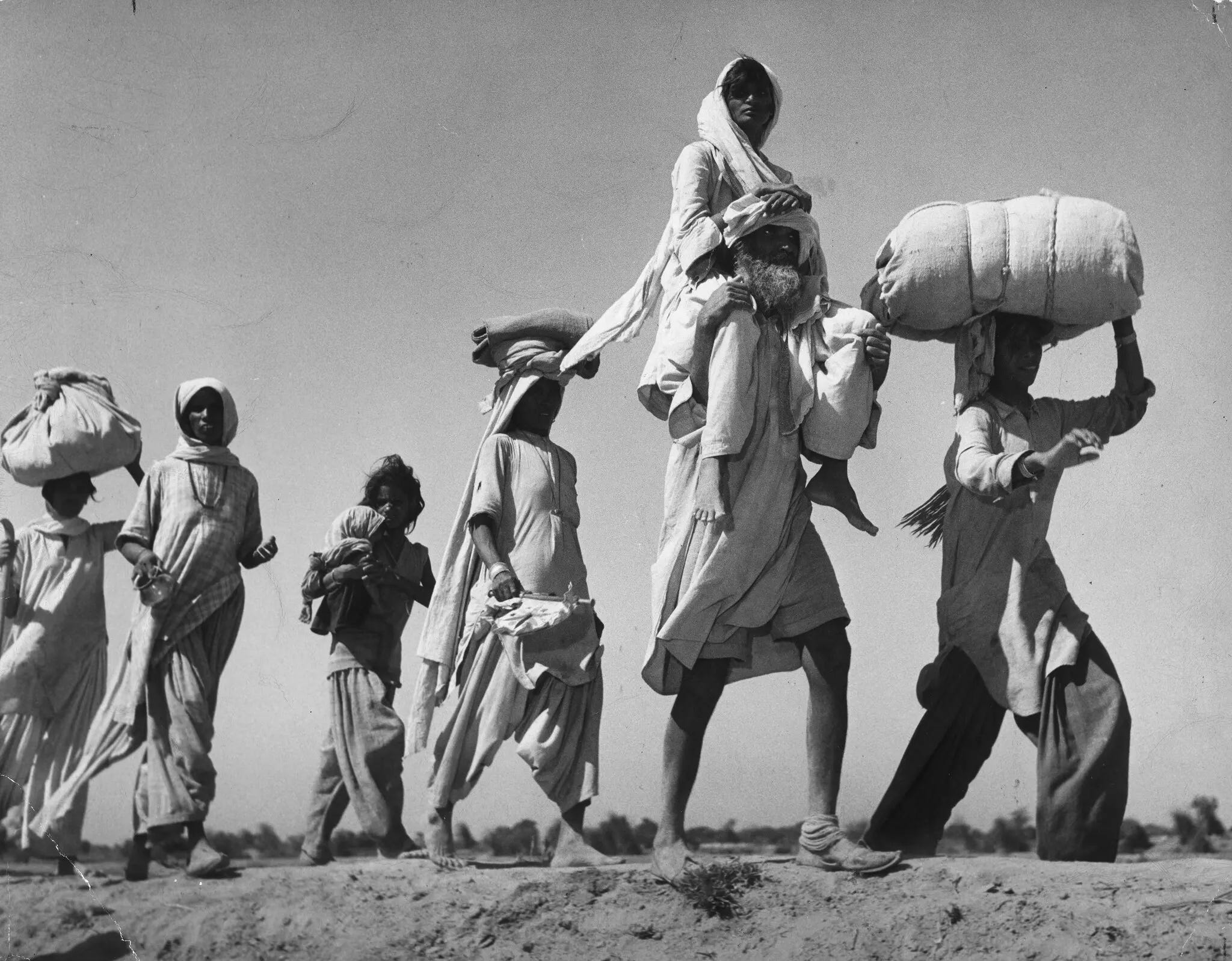
Seventy-eight years ago this week, Partition, the division of British India, displaced more than 15 million South Asians: Muslims to West and East Pakistan (now Bangladesh) and Hindus and Sikhs to India.
In my 2024 review of two middle-grade novels about Partition — Veera Hiranandani’s Amil and the After (2024) and Saadia Faruqi’s The Partition Project (2024) — in The New York Times Book Review, I referred to a “tiny canon” of books for children and young adults about Partition that are widely available in the United States, including:
The Night Diary (2018) by Veera Hiranandani, about twelve-year-old Nisha, forced to flee her home with her Hindu family, who finds her voice and makes sense of the world by writing to her deceased Muslim mother in the pages of her diary;
Chachaji’s Cup (2003) by Uma Krishnaswami and Soumya Sitaraman (illus.), a pioneering text about Neel, who learns about his family history and the Partition from his great uncle through stories told over a beloved old teacup;
The Moon From Dehradun (2022) by Shirin Shamsi and Tarun Lak (illus.), about Azra, who accidentally leaves her doll, Gurya, in Dehradun as her family makes a harrowing overnight journey to Lahore.1
Three books have since entered this “tiny canon”:
Lion of the Sky (2024) by Ritu Hemnani, which weaves historical information and Sindhi language into a powerful story about friendship and bravery, and which School Library Journal calls, “a culturally rich reading experience that is heartbreaking and inspiring”;
Veena and the Red Roti (2024) by Namita Moolani Mehra and Beena Mistry (illus.), a story about how food and flavor can help us feel at home, even in a refugee camp;
Zarina Divided (2025) by Reem Faruqi, a coming-of-age story about a Muslim girl who, during Partition, must learn to cope with loss, guilt, and change in order to grow.
Buy or borrow, as I always say. As a “granddaughter of Partition” — all four of my grandparents were displaced and spent time in refugee camps — I found echoes of my family’s experiences in all these books’ pages.
o o o o o
Six of these eight books are historical fiction. In compiling, I reflected on history in fiction and historical fiction as a genre, namely: What even is “historical fiction”? Is fiction whose publication was once contemporaneous with its readers now “historical fiction”? Which periods of South Asian/diaspora history have been written about for young readers in the United States and which have been overlooked — and why?
In The Distant Mirror: Reflections on Young Adult Historical Fiction, Joanne Brown and Nancy St. Clair share a definition for “historical fiction” that they deem “both concise and sufficiently encompassing.”2 In Sublime Desire: History and Post-1960’s Fiction, Amy J. Elias lists three primary characteristics that mark the genre:
specific historical detail… is crucial to plot or character development;
a sense of history informs all facets of the fictional construct;
this sense of history emerges from and is constructed by the text itself3.
Elias omits one final criterion that marks the genre, Brown and St. Clair argue:
Just as high fantasy involves a struggle between the forces of good and evil, historical fiction is marked by a clash between opposing socio-political powers. This conflict is represented variously in historical fiction that has been written as such, usually with reactionary characters pitted against a protagonist who signifies a more progressive element. And this criterion helps distinguish between fiction whose authors have deliberately sent their stories in the past and novels that gain the status of historical fiction with only the passage of time.4
Using this one set of criteria — probably imperfect and endlessly debated, I’m sure — I compiled this list of historical fiction novels about South Asia and/or South Asian diasporas widely available in the United States5:
Neela: Victory Song (2002) by Chitra Banerjee Divakaruni, set in colonial India in 1939;
Child of Dandelions (2008) by Shenaaz G. Nanji, set in 1972 during Idi Amin’s 90-day expulsion of Uganda’s Indian minority;
Keeping Corner (2009) by Kashmira Sheth, set in colonial India in 1918;
Climbing the Stairs (2010) by Padma Venkatraman, set in colonial India in 1941;
Ahimsa (2017) by Supriya Kelkar, set in 1942 in colonial India6;
Step Up to the Plate, Maria Singh (2017) by Uma Krishnaswami, set in 1945 in Yuba City among California’s Punjabi-Mexican community;
Orange for the Sunsets (2019) by Tina Athaide, also set in 1972 in Uganda;
Strong as Fire, Fierce as Flame (2021) by Supriya Kelkar, set in 1857 in colonial India in the aftermath of the Sepoy Rebellion of 1857;
I Am Kavi (2023) by Thushanthi Ponweera, set in Columbo in 1998 as the Sri Lankan Civil War is raging.
What books have I missed? I make no claim that this is a comprehensive list! What forthcoming books should I keep on my radar?
I interviewed both Shamsi and Lak for Publishers Weekly: Makhijani, P. (2022, August 11). Q & A with Shirin Shamsi and Tarun Lak. Publishers Weekly. Retrieved from https://www.publishersweekly.com/pw/by-topic/childrens/childrens-authors/article/90070-q‑a‑with‑shirin‑shamsi‑and‑tarun‑lak.html.
Brown, J., & Clair, N. S. (2005). The distant mirror: reflections on young adult historical fiction. Bloomsbury Publishing PLC.
Elias, A. J. (2001). Sublime desire: history and post-1960s fiction. JHU Press.
Brown, J., & Clair, N. S. (2005).
I omitted popular historical fiction books by Jean Bothwell, Deborah Ellis, Suzanne Fisher Staples, Gloria Whelan, etc.
I interviewed Kelkar for The Washington Post: Makhijani, P. (2017, October 13). Author of ‘Ahimsa’ talks about social justice, activism and parenting. The Washington Post. https://www.washingtonpost.com/news/parenting/wp/2017/10/13/author-of-ahimsa-talks-about-social‑justice‑activism‑and‑parenting.
This list is not complete without great book of Nandita Bhavnani great book "Making of the Exile" a very well researched book on Sindhis terrible forced migration! https://a.co/d/55RaelE